
Failure to Launch
The tragedy of spectator spirituality

At this point, we’ve become very good at deconstructing things.
We know how to critique systems. We know how to identify manipulation, abuse, propaganda, spectacle, institutional rot, and bad theology. We know what we don’t want.
But in the work of liberation—from empire, from false selves, and from inherited systems—critique is only the doorway. The real struggle lies beyond it.
This explains why so many of us now exist in a strange, suspended state. That liminal spot of not fully withdrawn yet not fully engaged, nor fully participating.
We are the frustrated spectators lingering at the threshold of radical change.
And we’ve been here before.
In Exodus 33, Moses establishes what’s called the “tent of meeting” outside the camp.1
“Anyone inquiring of the Lord would go to the tent of meeting outside the camp.”
Anyone?
Not just priests, elites, and experts.
Anyone.
To understand the archetypal pattern, that detail reeeaaalllly matters.
Within the broader tabernacle system there were clear boundaries between insider and outsider, sacred space and common. But here, outside the camp, Moses creates something so radically inclusive. A space meant to be ridiculously accessible.
A consecrated place of divine relational encounter.
The Hebrew phrase translated “meeting” (מוֹעֵ֑ד mow-ed) carries the sense of appointed or sacred time—moments where ordinary chronological existence (chronos) gives way to something deeper (kairos). Think Interstellar where time folds or thickens. Where infinite Presence interrupts sequence and reality becomes more wildly alive than manageable.
Moses gets all this already. By now, he has become well acquainted with mystical Presence, about friendship with the divine and face-to-face encounter.
If I were there as an onlooking Hebrew watching him disappear into that intimacy, into cloud and mystery while I remained outside it, I’d probably feel envy too.
What’s so special about Moses?
Apparently, nothing. That’s the uncomfortable implication of the story!
The tent is open and available. The threshold is so very crossable.
The people just don’t do it.
Instead:
“All the people rose and stood at the entrances to their tents, watching Moses…”
They just……. stand there.
Watching. They worship but from a safe distance.
They remain there as spectators. Observers.
Consumers of someone else’s encounter.
That’s the tragedy running underneath the story! It’s not about their violent or outright rebellion. It’s not their absence of belief. I mean, they do stand there… worshipping.
The real tragedy here? A mediated spirituality.
Someone else climbs the mountain. And someone else hears from God.
Someone else carries all that ambiguity, risk, intimacy, and barely bearable destabilization that is part of divine relational encounter.
The people remain safely framed within the safe confines of their own single family homes. Stalled out at the entrance.
The text reads like that doorway has become an impossible 50 foot unscalable wall. A threshold of the psyche. A limitation of imagination.
An invisible resistance of soul.
That’s the archetype and the same pattern we’re witnessing in our moment now.
Especially within the American enterprise of church.
We gobble up sermons, podcasts, books, discourse, liturgies, personalities, and movements. We curate safe identities around camps:
traditionalist,
progressive,
deconstructed,
orthodox,
inclusive,
liberated,
awakened.
Progressive spirituality is hardly exempt from becoming one more spectator sport.
We analyze systems and deconstruct trauma. We’ve learned to interrogate power, refine language, and perform with nuance.
And… much of it still remains just another version of standing at the entrance of the tent watching somebody else go in.
Different Moses. Same safe distance.
All this comes on the heels of the golden calf story in the previous chapter where the people construct the idol immediately after witnessing a thousand astonishing manifestations of divine presence.
Hungry? Here’s more than enough manna. Directionless and lonely? Here’s a comforting cloud for the day and a fire pillar for the night. Feeling threatened? Lemme just slide the water of the Red Sea to one side to create safe passage while eliminating your slave holders while I’m at it.
All the guidance, belonging, religious certainty, and visible signs you could ask for. What more could they possibly need?
Something a lot more safe and significantly more manageable. Spectatorship.
Spectatorship is ultimately safer than the pursuit of real sacred encounter. Nothing destabilizes the self like genuine relational encounter.
Ever been in love?
A real encounter with love dismantles self-sufficiency. It threatens and rearranges inherited identity. It pulls people outside the reassurance of collective consensus and individual performance.
The character of Moses is THE psychological illustration of the differentiated self. He walks outside the camp and outside the collective nervous system. Moses individuates beyond the pervasive gravity of group identity.
That’s where the transformation, the healing, the evolutionary magic happens.
Over a thousand years later, Jesus carries this same energy when he tells his followers:
“You will do the works I have been doing, and even greater things than these.”2
Was there anything Jesus had that the disciples didn’t? Can I at least ask the question? Jesus telling his followers about the coming comfort of the Spirit conveyed the same message as Moses’s inclusive tent of meeting, you too have a relational portal to sacred time.
The implications are staggering.
The portal into sacred presence is not exclusive and the access points are not reserved for spiritual celebrities. Dude, you too can enter.
But that much freedom is disorienting.
I immediately remember the character of old man Brooks from The Shawshank Redemption.
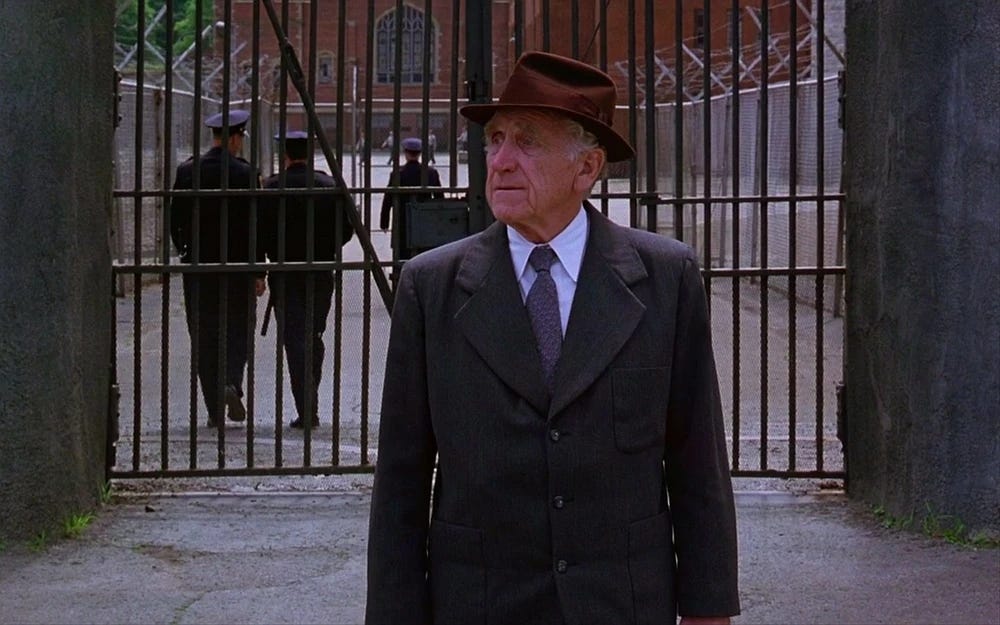
After fifty years of institutionalization, that much freedom becomes unbearable to him. Prison at least gave him structure, predictability, and identity. Someone else defined reality for him.
Freedom sounds beautiful until you actually have to inhabit it. This is why golden calves remain endlessly appealing.
This is why so many of us still stand at the entrance of our tents,
watching someone else disappear into the liberating mystery of the cloud.
Deconstruction is doing its work in exposing the false gods. But eventually, every liberated person must still decide whether they want to enter the tent of sacred time.
Otherwise critique itself becomes just another golden calf for us to gather around.
Exodus 33:7-11 NIV
7 Now Moses used to take a tent and pitch it outside the camp some distance away, calling it the “tent of meeting.” Anyone inquiring of the Lord would go to the tent of meeting outside the camp. 8 And whenever Moses went out to the tent, all the people rose and stood at the entrances to their tents, watching Moses until he entered the tent. 9 As Moses went into the tent, the pillar of cloud would come down and stay at the entrance, while the Lord spoke with Moses. 10 Whenever the people saw the pillar of cloud standing at the entrance to the tent, they all stood and worshiped, each at the entrance to their tent. 11 The Lord would speak to Moses face to face, as one speaks to a friend. Then Moses would return to the camp, but his young aide Joshua son of Nun did not leave the tent.
John 14:12 NIV
12 Very truly I tell you, whoever believes in me will do the works I have been doing, and they will do even greater things than these, because I am going to the Father.
I feel lucky to have so many spiritual directors around me that are willing to go into the tent. You are one of the main ones, Ryan! I’m loving my journey of exploration into spirituality right now. I think being casually raised in a non-evangelical PC-USA church gave me permission from youth onward to not be rigid in doctrine. Being open to experiences has helped me live in sacred time a few times and how I always long for it. For this I am very grateful! Thanks for your eloquent guiding reflection today that makes me excited to explore more of this!
Are we spectators … OR those hero archetypes who are like the Teddy Roosevelts “man in the arena” ?
Or is there a 3rd way?
… One with no reference point whatsoever ?